Sun 1 Nov 2009
In September 1984, a friend of ours, Jane Sharding, one of the city’s best organists and choir directors, was going to Paris, and she asked me, in full blithe innocence, if she could bring me
something. You know how people do that on the eve of departure, with a little laugh, expecting you to say, “Oh, don’t bring me anything, just send a postcard.” Well, I had been poring over Steven Spurrier’s The Concise Guide to French Country Wines (Putnam/Perigee Books, 1983), and I replied to Jane’s jocular aside with goober-like seriousness and a list of wines and directions to Spurrier’s intimate, little shop, Les Caves du Madeleine. Spurrier is the Englishman who engineered the famous “Paris Tasting of 1976″ in which a California chardonnay and cabernet sauvignon “beat” exemplary models from Bordeaux and Burgundy.
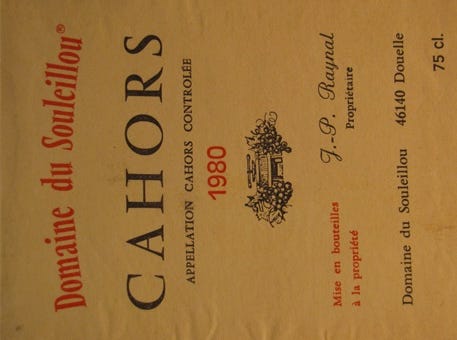
Anyway. Jane came through like a good sport and a trouper and returned to Memphis with three bottles of red wine in a sturdy cardboard carry-box. They were: Château de Beaupré Cuvée Spéciale 1981, Coteaux d’Aix-en-Provence; Domaine des Féraud 1981, Côtes de Provence; Domaine du Souleillou 1980, Cahors. The first two were interesting, educational, enjoyable; the third was the knockout.
I had read in various books that Cahors, dominated by the malbec grape, there called auxerrois, produced tough, rustic, full-bodied “black wines” that provide appropriate accompaniment to the local hearty cuisine; it’s perfect with cassoulet. Cahors lies athwart the Dordogne river in a rugged area southeast of Bordeaux and is even today not easy to reach. I visited the region and city in 1990, driving up from Toulouse by a wildly picturesque route.
The Domaine du Souleillou 1980 wasn’t exactly black, more like deep, dark ruby-garnet. Rustic, though, yes, I will admit to that quality, by which I mean unpretentious, unsophisticated, honest and forthright. But not simple: There were complexities of ripe, dusty currant and plum scents and flavors, sort of buried in briery tannins, port-soaked fruitcake, woody spice and mossy-like earthiness. This was intense and heady stuff, unlike any wine I had encountered. I didn’t record what we ate with the wine; it was clearly not made for lighthearted sipping. I opened it on Oct. 4, 1984, so I assume it went with something flavorful and autumnal.
This is, by the way, my favorite kind of wine label, nothing gaudy, neither ostentatious nor tricked out with japes and frippery. It’s as honest in lay-out and typography as the wine was in its construction and essence. The fact that the words “Domaine du Souleillou” are set on a slight curve and that the name of the proprietor is in cursive lends this artless label a touch of elegance. I’ll let Benito, who ought to have a separate blog about wine labels, offer his knowledge about the typefaces, but I think he would agree that this label illustrates the epitome of clarity and good sense.
November 1st, 2009 at 1:57 pm
This would have been printed at an odd time–the shells were likely made sometime in the 70s, and the winery would have had several years’ worth of label sheets printed with the date overstamped as needed per bottling. (That’s why so many older French labels have the year in red, or sometimes the year looks a little offset to the rest of the text.)
Proper identification is beyond my skills, because at the time this could have been laid out on anything from metal type to a primitive computer. The Domaine line is in something like Bernhard Modern Condensed, “Cahors” is definitely in the Trajan family (going back to the 2nd century Roman empire), and I don’t have quite enough info to identify the script font. But I mocked up a quick forgery using the major design elements I mentioned here–I didn’t bother recreating the small Roman text, but could do so if I had to.
http://i34.tinypic.com/akepeh.jpg
November 1st, 2009 at 9:32 pm
Aw, it’s not that hard to get to Cahors now. You just zip up the A20 and get off at the D 911/Cahors South.
I envy you the experience of drinking a Cahors from the good old days! Lately, I see less 100% malbec, and more with 20% merlot to soften the wines up for earlier consumption.
I’m impressed the wine came off as well as it did after only four years. But also not surprised that the experience was so clearly memorable.
November 2nd, 2009 at 8:17 am
Those kinds of labels remind me of passport stamps, with their off-kilter look.
The one thing I learned while visiting Cahors, a drive from Bordeaux, but a nice drive, you can–no, you must–drink the red wine with whatever is on your plate.
Good idea to get up to, and then down into, the prehistoric Pech Merle the next time there.