Mon 3 Aug 2009
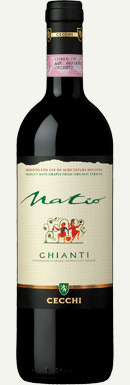
I recently received a bottle of the first issue of Cecchi’s Natio Chianti 2007, a wine made from organic grapes certified by CCPB. The front label states, “Product with Grapes from Organic Farming,” while
the back label says, “Made with Organic Grapes.” Notice that the phrase “organic wine” is not used. That’s because in order to be called “organic wine” that wine would have to be not only made from certified organic grapes but every step of the winemaking process would have to be certified organic, something that the governments and certifying agencies of the world have not figured out a way to measure and regulate.
It’s not mentioned on either front or back label, but Natio Chianti 2007 is suitable for vegans (and possibly Venusians) because, as the press materials state, “No animal by-products were used in production.” And you, My Readers, are thinking, “Animal by-products? Gack! What in heck-to-Remus are you talking about?”
Allow me to explain. One might assume that wine is completely safe for cuisineophiles of every persuasion, from outright carnivores to the most fragile of picky macrobioticists, but such is not the case. There is more to wine than mere water, alcohol and chemicals. A process in winemaking called “fining” has traditionally employed substances from the animal kingdom (or from the fridge, to be practical about it). After fermentation, wine is usually left with a multiplicity of microscopic elements called colloids. Typically, a wine that offers a plush or viscous texture contains more colloids than a light, more delicate wine; removing colloids can also make a wine astringent, though they lend a wine detail and dimension. Fining, in other words, represents a trade-off in terms of a wine’s character, but the process also clarifies wines and eliminates cloudiness or haze.

Substances used in fining are ancient (relatively speaking) in origin; they include egg whites, milk, isinglass, made from fish bladders, and (not so ancient) bentonite, a form of clay found chiefly in Wyoming. These substances are harmless and are almost completely absent from the finished wine. Each has advantages and disadvantages — bentonite is so absorbent that it can diminish the flavor of a wine — but nobody, on the other hand, is going to buy a bottle of wine that isn’t perfectly clean and clear.
Naturally, the idea that wine may contain a glimmer of a molecule of egg white or milk makes it inappropriate for vegetarians or their more extreme cousins, the vegans. Very few wineries allow this
sort of information to be printed on their labels because the it would sound more scary than helpful. An exception is Randall Grahm, owner of Bonny Doon Vineyards, who a couple of years ago, after he took the Ca’ del Solo vineyard biodynamic, began stating on back labels the ingredients in the wine and the substances used to make the wine, including fining agents. I doubt if many (or any) producers will follow his lead, at least until government regulations require such statements, as inevitably they will. Grahm is predictably ahead of the curve.
I asked Jane Kettlewell, director of public relations for Banfi Vintners, whose Excelsior Wine and Spirits division imports the wines of Cecchi, why the vegan opportunity was not explored on labels of Natio. Here is her reply:
“It seems there was very little space indeed for back label copy and the conclusion was that as most wines do at some level have some connection with an animal by-product, that vegans don’t tend to be wine drinkers. This seems like a Catch 22 situation – the vegans won’t find us if they’re not aware of the vegan-friendly nature of this wine, but on the other hand, vegans aren’t stampeding into wine stores to begin with.”
True enough, but I hate to think of vegans not enjoying wine with their tofu enchiladas because of a fear of wine’s supposed animal connection.
And the wine? Well, the Cecchi Natio Chianti 2007 falls into the category of Decent Quaff. We drank the bottle with pizza Saturday night and that sums it up: An enjoyable but not memorable Chianti, a little rustic, but delivering authentic sangiovese scents and flavors of dried fruit, dried flowers and spice in a good structure that balances tannin and acid. A meatloaf, burger, pizza wine. Very Good. About $16. I would be more comfortable if it cost $12 or $13, but everything organic is more expensive. It costs to be natural.
Carton of eggs image from middlezonemusings.com. Glass of milk images from bedzine.com.
August 4th, 2009 at 5:24 pm
Fredric,
I had a vegan friend who drank wine and she said that after realizing that yeast cells had to give their lives for wine to be produced, she lowered her vegan standards.
August 4th, 2009 at 5:54 pm
ha, but yeast cells are plants anyway, right? or are they actually alien spores, migrating across the cosmos to turn our minds to mush, using the medium of alcoholic beverages, and conquering the earth? hmmm, I think I better start writing this as a script for Hollywood.
August 4th, 2009 at 6:01 pm
Yeah, you can call it Yeastanator!
August 4th, 2009 at 6:45 pm
Yeast is a fungus, neither plant nor animal; a tiny eukaryotic chemotroph.
But your script isn’t too far off. Toxoplasmosis is spread through cat feces, and is caused by a single-celled organism. The microorganism actually infects mice and rats first, where it causes them to lose their fear of cats. Then the cats eat the now-gullible mice, and later humans and other animals get infected and the process starts all over again.
August 4th, 2009 at 8:15 pm
Benito,
The last encounter I had with a single cell organism I was living in Tehran and I met with a guy named amoebic dysentery…oh what fun it was to ride the dasshui!
August 5th, 2009 at 2:14 am
Thomas,
The amount of human behavior driven by parasites is staggering. Even our lust for figs primarily benefits a certain species of wasp.
Study enough biology and you cease to view yourself as a single organism but rather as the carrier of, and farmer of, millions of little critters you never see.
August 5th, 2009 at 7:03 am
Benito,
If I never see the amoeba again life will remain good.
Yes, it is a wonderland of interdependence. Does that square with Fredric’s distaste for placing desire values on inanimate things?
More important: what’s the reason for the existence of Japanese beetles. I want them all dead!!!
August 5th, 2009 at 8:37 am
I don’t get the whole Vegan thing. It is beyond nutty to view the world this way. Having said that, I understand that this is my opinion and life choice and people are free to do what they want with there bodies and money.
I think maybe part of it comes down to economics. We have more money and at least in the western world most people aren’t starving. I read that during WW II in Italy, it got bombed so heavily, that people were eating anything, including cats. These old timers talked about how tasty they were.
If things got to where people were really starving again and eating to live, I wonder how many Vegan and Veggies there would be.
Again, this is just my opinion.
August 5th, 2009 at 1:29 pm
Thom,
My understanding is that vegan is more a political statement about the negatives connected with eating living creatures. Plants are not considered living things–and that shows how little most people know of plants!
August 5th, 2009 at 2:59 pm
Ah yes…. I think much easier to be political with a full stomach. I think most people would have a different point of view if they and their family were starving to death.
August 5th, 2009 at 5:32 pm
If I ever have a rock band, it will be called “Desire Values of Inanimate Things.”
August 5th, 2009 at 7:21 pm
Fredric,
Do I get anything for the copyright on that name???
August 5th, 2009 at 9:47 pm
In the winery where I work we use bentonite and isinglass…had fun with a lady once who was a vegan and didn’t realise we used the old fish bladder routine…she nearly passed out, it was quite extraordinary. I thought it (secretly)amusing, not so much her husband as he stopped her falling onto our tank room floor. Oops!
August 6th, 2009 at 5:12 pm
Ha ha! Oops, indeed, Vinogirl, I’m surprised there wasn’t a lawsuit.
September 24th, 2009 at 4:31 pm
Thomas,
Your understanding is not correct – vegans know plants are living things, but they also believe plants have no, or very little, consciousness and no ability to feel pain since they lack a nervous system. In fact, they lack neurons. Hence why vegans have no problem eating plants but do have a problem eating animals.