Tue 21 Jul 2009
It’s too bad that sherry is such a misunderstood and abused wine, because its pleasures are manifold and even endowed with nobility. Unfortunately, describing how sherry is produced in a couple of
paragraphs is like trying to summarize the Matrix Trilogy in an hour — “O.K., so, then Neo goes into this dark place that’s sorta like Purgatory and sorta like an android mosh pit, see, and then …” — but I’ll give it the ol’ college try.
Sherry — the name is jealously guarded by international trade agreements — is made only in the arid region around the seacoast city of Cadiz in way far southern Spain, around on the Atlantic side, west of Gibraltar. The combination of grapes varieties, the chalky soil, proximity to the ocean, the close to drought-like climate — annual rainfall is 19 inches — and the unique solera process result in a wine that at its best rivals the great wines of Europe’s other famous winemaking regions. The corollary is that lots of anonymous, generic, mediocre sherry is also produced.
Sherry is a fortified wine made principally from the palomino fino grape (95 percent) with some estates still cultivating minuscule amounts of Muscat of Alexandria and Pedro Ximenez, the latter for dessert wines that can attain legendary qualities. After fermentation, the wines are fortified with grape spirit to 15 or 15.5 percent (for elegant fino sherry) up to 18 or 19 percent for richer oloroso style sherry. The lower alcohol content in fino sherry does not inhibit the growth of the flor, the natural yeast the grows across the surface of the wine in the barrel and contributes to fino sherry its typical and unforgettable light mossy-nutty character. The sherry houses are situated in three towns, Jerez de la Frontera — “sherry” is an English corruption of “jerez” — Sanlucar de Barrameda and El Puerto de Santa Maria; though geographically not too distant from each other, the three locations impart different qualities to the fino sherries that originate in them.
The solera system is essentially a method of blending in which some of the oldest wine is withdraw from its barrel and topped up with the next oldest and on down the line to the youngest wines that entered the solera after fermentation and fortifying. The constant process of topping off in this manner keeps refreshing the older wines and ensures a steady house style year by year. Some houses run complicated systems of as many as 20 different solera to satisfy the demands of the different types of sherry that they produce. Unfortunately, modern times have seen the adulteration of the method through shortcuts and the addition of sweetening agents, mainly used for cheap versions and for so-called “Cream Sherry.”
The types of sherry can be confusing, certainly as confusing as the many types of Port. Basically, the system goes like this: Fino is the most delicate and elegant of sherries and the best to be served with tapas and other light appetizers. A fino from Sanlucar is a Manzanilla. If a fino, either through natural process or induced, loses its flor, the increased exposure to air will result in a darker, more flavorful sherry; this is the famous Amontillado. The sherries called Oloroso, fortified after fermentation to around 18 percent alcohol, never develop flor, and so their character is far different, being darker in color and more intense and concentrated. All of these are dry wines. The rarest and best sweet sherries are made from sun-dried Pedro Ximenez grapes, though vast quantities of sweet sherries are turned out using other, cheaper processes.
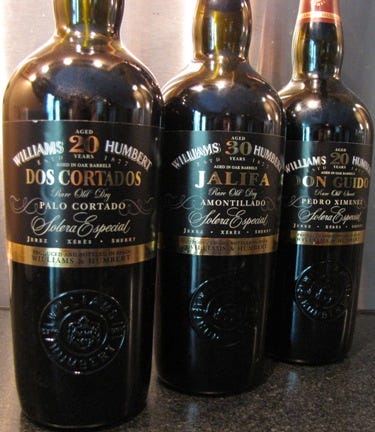
The motivation behind this brief disquisition is the tasting I did recently at home of three spectacularly good aged sherries from the house of Williams Humbert. These qualify for the recently permitted designations of V.O.S. (“Very Old Sherry”) if the wine has aged at least 20 years and V.O.R.S. (“Very Old Rare Sherry”) if the aging has been at least 30 years. These are sherries to be savored slowly,
thoughtfully and appreciatively at the end of a meal, not to be partaken of as an aperitif or with tapas. For that function, there are many choices, but one of my favorites is the Emilio Lustau Solera Reserve Jarana Fino, as light, as dry, as delicately nutty, as elegant as you could desire (Excellent, about $19).
By the way, fino sherry should be served chilled, the others at room temperature.
The Williams Humbert sherries are imported by Kindred Spirits of North America in Miami, Florida.
______________________________________________________________________________________

The William Humbert Dos Cortados Rare Old Dry Palo Cortado Solera Especial falls between an Amontillado and an Oloroso style sherry; it spends at least 20 years in the solera. The color is medium-amber suffused with old gold. The bouquet is an intoxicating wreathing of roasted hazelnuts, toffee, baked apple, orange rind and toasted coconut. After such a heady display of aromas, it’s startling how dry, I mean bone-dry, this sherry is, both sensuous and austere; it tastes like smoldering peat, iodine, sea-salt and woody spices bound in a sumptuous yet not overwhelming texture that flows liberally across the tongue. There’s an after-burn of alcohol, spicy wood and vanilla. Quite a performance. Excellent. About $50.
_____________________________________________________________________________________

Well might one cry, “For the love of god, Montressor!” The Williams Humbert Jalifa Rare Old Dry Amontillado Solera Especial spends at least 30 years in solera. The color is medium-amber with a hint of green-gold. It smells like scotch, warm, enrobing, inviting, richly spiced; one understands why wars were fought over cinnamon and cloves. Again, a briskly dry sherry (but so mellow, so smooth!) that embodies elements of pomander, wheatmeal, orange marmalade, the blondness of sawdust, the characteristic dusty woody (and woodsy) earthiness and mossiness, all given bass tones by a strain of deep, dark bitter chocolate. Oh yes. Exceptional. About $70.
_____________________________________________________________________________________

Made from sun-dried grapes and aged at least 20 years in solera, the Williams Humbert Don Guido Rare Old Sweet Pedro Ximenez Solera Especial offers the color, but not quite the viscosity, of molasses. This, friends, reaches the Platonic extents of sweetness along an astonishing depth and range of effects: smoky brown sugar, roasted raisins, rum raisin ice cream with bananas Foster, almond brittle, orange zest and orange blossom honey. This is almost shamelessly enjoyable, but it does not offer quite the dimension or complexity of the Dos Cortados or Jalifa Amontillado, though its vibrancy, resonance and sheer appeal-power are admirable. Excellent. About $50.
_____________________________________________________________________________________
July 22nd, 2009 at 8:58 am
I find it interesting that do to current “trends” there are wines like Sherry,Port,Grand Cru Beaujolais, German Riesling that for what ever reasons, just haven’t taken hold of the wine world like big Cabs,Champagnes, and Pinot Noir.
The top made wines are a fantastic value relative to the production and care given to making these wines. They all have centuries of history and expertise, not to mention a proven track record of producing GREAT wines over many many years.
I guess on a selfish level, I should be grateful that they are out of fashion and that allows me the opportunity to drink the equivalent of great Burgundies and Bordeaux’s in these wines.
Yet, it still amazes me that any Tom , Dick or Harry can bring a big wad a cash into the business and gain instant cult status.
Oh well, a fool and his money…….
It was a great post.
July 22nd, 2009 at 10:45 am
Thanks, Thom, I agree that compared to other wines of equal status, great sherries are underpriced. Even the best finos still come in at $18 to $25.
July 22nd, 2009 at 9:10 pm
I’m a Manzanilla sipper, while cooking.
July 23rd, 2009 at 8:19 am
Must. Run. To Wine Store. Now.
July 23rd, 2009 at 10:40 am
you know, a fino is a great match, in the spring, with a green pea soup that’s lightly laced with the same sherry. we tried serving this to friends last year, and they eyed the fino with great suspicion, took a sip and declined to drink any more of it. they were happier with a sauvignon blanc.
July 23rd, 2009 at 4:05 pm
Fredric,
Sherry in soup is a must-do.
A Prohibition loophole included that U.S. sherry could be sold to companies like Campbell Soup, and was.
July 24th, 2009 at 1:54 am
Thomas,
I also like the loophole that certain heavily-peated Scotches were classified as medicine because customs officials couldn’t imagine anyone drinking them for pleasure.
Sherry took me a while to like. I had some Amontillado when I was 21 and, well, it was part of a rather unpleasant evening. I had to struggle to swallow it. I had a cream sherry a few years later and still couldn’t stand it. Then I had a good one around age 28, and loved it.
Did I just have to wait for a good one, or is it one of those things that requires a certain maturity of the palate? No idea, but my sherry vinegar is now one of my prized ingredients.
Cheers,
Benito
July 28th, 2009 at 12:51 pm
Thanks!
I’m a gigantic Sherry advocate and will take any opportunity to try to turn someone on to it… it makes it easier that the restaurant I work at has nearly 20 by the glass (Salt Tasting Room).
I have yet to try William & Humbert’s aged line, but they look delicious…especially the Oloroso. Gonzalez Byass does some fantastic old bottlings as well… particularly the Apostoles Palo Cortado. Cheers
July 28th, 2009 at 1:29 pm
The restaurant where Jake works is in Vancouver. here’s a link to the wine list, which is short but very thoughtful:
http://www.salttastingroom.com/winelist.pdf