Mon 4 May 2009

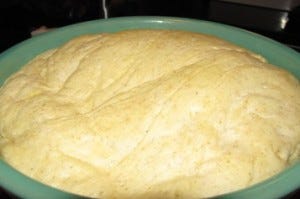
All right, readers, Part 1 of this two-part series got your pizza dough to the point where it’s rising in a bowl in a warm, nurturing spot (like Mom, back in the day), and now it’s all high and light and puffy (like me, back in the ’70s), and it’s time to take that dough, make it flat, put some toppings on it and get it into the oven! Yes!
First, a word about ovens and temperatures. Now most regular people who live in regular houses in regular cities don’t have wood-fired brick ovens at their disposal. They’re expensive to build, they take up space on the patio, and they require city permits to construct and use. Of course people are always saying that you cannot make good (or “adequate”) pizza without a wood- or coal-fired brick oven that maintains 800 or 900 degrees, that without that blast of heat you’ll never get a truly great crust with “blackened blisters” on it. Well, it’s correct that without 800 or 900 degrees of heat, you will not get the charred effect on the bottom of the crust — though you can finish the pizza on a charcoal grill — but at the 500 degrees that domestic ovens provide you will get a lovely, brown crusty crust, as the images further along in this post will prove.

So, turn your oven on to 500 degrees an hour before you’re going to slide the pizza onto the stone. Oh, yes, you absolutely must have a pizza stone in the oven, or at least some flat, unglazed tiles. I have been using the same stone for at least 15 years; the surface is completely black now, but it does its job of conducting heat exactly as it should; I like knowing that when the pizza touches the heated stone, it starts cooking instantly.

For our pizza tonight (well, Saturday night) I am avoiding tomatoes, not that there’s anything wrong with tomatoes, but I’m a little weary of pizzas dominated by their influence. So the principal toppings of this pizza will only be items that LL bought at the Farmer’s Market Saturday morning: arugula, spring onions, shiitake mushrooms and Italian sausage. In addition, there will be rosemary and thyme, mozzarella and Parmesan cheeses. I do not, by the way, make pizza with a sauce; tried it once, years ago, didn’t like it. In the case of this pizza, of course, the first thing I did was cook the sausage.
______________________________________________________________________________________

Now, generously sprinkle cornmeal on the paddle, or, as these devices are called in professional circles, when they’re more likely to be metal instead of wood, the “peel.” In addition to cornmeal, I use a little flour, just to ensure slippy-slidy action when the time comes. We’re going to be using a rolling pin to flatten and spread the dough — none of these tossing the dough into the air theatrics — so put a little flour on the rolling pin and on your hands too.
Whoa, there’s the risen dough, all light and soft and puffy. With both hands, plunge into the dough, pick it up, knead it a few times, and plunk it down on the paddle. Flatten it with your hands for a
minute, spreading it out a little. Then start to work with the rolling pin, going at the dough from different angles. If it gets a little sticky, sprinkle on some flour. When the dough seems as if it has gone as far as it wants to, or if it wants to contract, let it rest for five or six minutes. Remember that the gluten in flour makes dough elastic, so if you go back to it after letting it alone — you can be slicing and dicing while it rests — you can roll it the rest of the way and it will be fine. The amount of dough you have should produce a 16-inch pizza, or something in that range.
_____________________________________________________________________________________

Pour a small amount of olive oil on the flattened dough and spread it around with your hand.
_____________________________________________________________________________________

Now we start to build the pizza itself with the toppings. First the arugula and the sliced shiitake mushrooms.
_____________________________________________________________________________________

Next, the sausage and the spring onions.
_____________________________________________________________________________________

Mozzarella and grated Parmesan.
_____________________________________________________________________________________

Once the toppings have been assembled — including fresh or dried herbs, salt and pepper — dribble a little olive oil across the top of the pizza. Remember that when you’re putting the toppings on the dough to leave an inch around the rim free, so it will rise and make a crusty edge.
_____________________________________________________________________________________

Now, carefully, run a spatula all the way around the edge of the pizza, checking for places where it might stick to the paddle. If necessary, shove a little cornmeal back under the pizza at the appropriate places.
_____________________________________________________________________________________

When the pizza is ready to go into the oven, open the over door, pull out the shelf with the stone, and carefully, using the spatula and all the finesse and “English” of which you are capable, slide the pizza onto the stone. It never gets easier; it never gets less nerve-wracking.Just get it over with. In a 500-degree oven, the pizza should take about eight minutes to cook. Visual checks every two minutes are important; when you see the risen areas begin to turn brown, take the pizza out and tap on the bottom; if it sounds solid and hollow at the same time, it’s done. If not, give it another minute.
_____________________________________________________________________________________

In the meantime, while the pizza is cooking, you might clean up the kitchen a bit. Lord have mercy, this place is a wreck!
______________________________________________________________________________________

Whoa, here it is, the pizza!
______________________________________________________________________________________

And a close-up.
______________________________________________________________________________________

And look here: The inside of one of the puffy, crusty places. That’s yeast and gluten and heat at work!
______________________________________________________________________________________
Any questions? You know where to find me.
May 5th, 2009 at 12:06 am
I love the rapt attention of young Q there, who I’m sure feels as though he has landed in dog paradise.
I couldn’t really tell from the photos; are you using fresh mozzarella?
May 5th, 2009 at 6:46 am
oops, sorry, yes, fresh mozzarella, sort of sliced or torn off and placed around the top of the pizza, then the parmesan.
our tomato-loving dogs were v. disappointed that i didn’t use tomatoes on this pizza.
May 5th, 2009 at 7:31 am
I could never get a dog to eat tomatoes, but I also could never stop a dog from eating fresh mozzarella!
I’ll trade you dogs…
Do you make the mozzarella, or is that asking too much of you?
May 5th, 2009 at 10:09 am
Thomas, I have made ricotta a couple of times but not mozzarella. it just seems like too much trouble. and yes, our dogs like mozzarella too!
May 5th, 2009 at 1:26 pm
[...] describes the dough-making process. I’m already jealous of his six-burner industrial stove! In Part Two, he rolls out the dough, tops it under the watchful eye of a great-looking dog (you thought all [...]
May 6th, 2009 at 7:16 pm
FK: Thanks for sharing your recipe, and to LL for the outstanding photos. Tried it tonight(with a few modifications, of course) and it was excellent. I always use parchment paper when making pizza, which avoids the problem of the pizza not slipping off the peel when placing it on the stone. But my version had large air pockets–which I pierced with a knife, but it still caused most of the cheese to gravitate (slide down the mountain) to the areas without air pockets (almost like two different pizza!) I wonder if the parchment paper doesn’t let the moisture escape into the stone or evaporate? I also used a sauce (from Walmart–not quite Costco I guess but close) called Classico “Sun Dried Tomato Pesto”–comes in 10 ounce jars. Give it a try.
Bruce B.
Hendersonville, NC
May 7th, 2009 at 8:18 am
FK,
Thanks for this (and thanks to Eric Asimov for pointing us). One question – in your experience, for two or more pizza can the dough recipe be doubled (tripled?), or would it be best to do separate batch for each crust? Judging by how good your pizza looks in the photos, one could never be enough!
JB
May 7th, 2009 at 9:42 am
Good question JB. I have made as many as five pizzas from one (large) batch of dough with no harm to the quality of the crust, so doubling the recipe should be no problem.
Bruce B … my wife and I spent a night in Hendersonville many years ago. we stayed in a B&B in a Victorian house filled with antiques and ate dinner at a pretty good “contemporary American” restaurant called Impressions, with a good wine list.
Anyway, parchment paper! I never thought of that. Don’t worry about the air bubbles and don’t pierce them… they’re part of the character of the pizza. so a little cheese slides off, no big deal. remember, once they’re in the oven, pizzas become their own masters, and you have to allow them some individuality.
May 8th, 2009 at 10:12 pm
One question after reading part one and part two…when are you coming up to visit us in Hoboken and create some pizza magic for us?! It’s been too long, I hope to see you soon. PS, your tomato loving sous chef is adorable!
May 10th, 2009 at 10:45 am
Looks great, but I was wondering what adjustments would you make if using a stand mixer?
May 10th, 2009 at 1:52 pm
a.l., I’ll confess that I have never made bread or pizza dough using a mixer, so i couldn’t tell you what differences there might be in the ingredients or how it’s put together. Many books exist, though, on making bread and bread-like dough with stand mixers.
KZ, my friend, I don’t know when I will be up in your direction anytime soon, but i will certainly let you know. My “sous chef” by the way is a rare Carolina Dog, one of a group of puppies we were fostering, and he turned out to be such a great dog that we paid the fee to the rescue group and kept him.
July 13th, 2010 at 11:27 pm
Looks great, Fredric! That crust looks particularly good …… now I am hungry