Sun 3 May 2009
Writing about wine and pizza on his blog The Pour, Eric Asimov
expressed hope that someday I would record my recipe or method for making pizza, a food, an issue, a concept that I mention frequently on BTYH.
Whatever Eric wants, Eric gets!
Yesterday, as I traditionally do on Saturday, I made pizza, in anticipation of pizza and movie night (Frozen River). LL was right there with the camera, photographing the process step-by-step, and in this post, we present “Making Pizza, Part 1,” devoted to the making of the dough. Just as great wine begins in the vineyard, great pizza begins with the fashioning of the dough that become the all-important crust, the vehicle for everything else. The ideal is a crust that’s thin without being crisp; that’s slightly chewy; that holds up under the weight of the toppings; that puffs up nicely around the edges.
Here’s what you need:
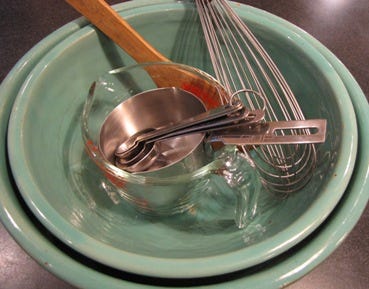
EQUIPMENT
2 bowls, one medium-size for mixing the dough, one smaller for letting the dough rise.
A 1-cup measuring cup for flour.
A 1-cup measuring cup for liquid.
Measuring spoons.
A wooden spoon, preferably flat, with a rounded edge.
A whisk, to dissolve the yeast in water.
A cutting board or other surface on which to knead the dough.
INGREDIENTS

Bread flour (preferably) or all-purpose flour. (Bread flour really is better, and the best is King Arthur.)
Rye flour (optional).
1/2 tsp of active dry yeast. (Could be more; see note below.)
Olive oil.
Salt.
_____________________________________________________________________________________
1. Let the tap run until the water is hot enough to feel it but not too hot. Pour 1/2 cup warm water into the mixing bowl, scatter 1/2 teaspoon of yeast onto the water and stir with the whisk to dissolve the yeast. Let stand for 8 to ten minutes.
Note on yeast: I like a long, slow rising for the dough, hence the small amount of yeast, 1/2 teaspoon; the dough will rise for six or seven hours. If you use 1 1/2 tsps of yeast, the dough will rise in two or three hours.
_____________________________________________________________________________________

2. When the yeast has thoroughly dissolved, pour 1 cup of flour (plus 2 tbsp of rye flour if you wish) into the water and mix with the wooden spoon to form a rough ball. Ultimately, you’re aiming at a dough that comprises 2 1/2 to 3 cups of flour for one pizza crust that’s about 16 inches across. The rye flour adds a little texture to the crust and a hint of rustic flavor.
_____________________________________________________________________________________

3. Add another cup of flour, several pinches of salt and about 1 tbsp of olive oil. Pour onto the flour another 1/2 cup of warm water (about) and mix until the water is absorbed and the dough forms a larger ball.
Note on water: You want a dough that’s slightly wet without being sticky. The wetter the dough is, the stickier it will be and the more difficult it will be to shape and knead it. On the other hand, you don’t want a dough that’s too dry. A slightly wet dough, as long as it can be handled, really makes a better crust.
_____________________________________________________________________________________
4. So, add a little more flour if necessary or a little more warm water if necessary to get the right balance of “wetness” in the dough, and to get 2 1/2 to 3 cups of flour going, but do so carefully, testing the dough’s consistency with your fingers.
____________________________________________________________________________________

5. Lightly scatter flour on the cutting board or whatever surface you’ll be using, and turn the dough out onto the floured surface. Shape the dough into a ball with your hands. Keep a measuring cup with flour close by, because you’ll need to use a little flour on the dough if it starts getting too sticky to knead. You can scatter the flour on the dough or on the cutting board, but don’t use too much.
_____________________________________________________________________________________

6. Press down on the dough with the heels of your palms, pushing the dough away from you. Scoop up the dough, give it a quarter-turn and fold it over, slap it down and repeat the process. Yay, you’re kneading the dough! This takes a little practice if you have never kneaded dough, but once you get it, the whole thing feels quite easy and natural. Knead the dough for six to eight minutes, flouring if necessary, until the dough is smooth.

_____________________________________________________________________________________

7. Pour a little olive oil into a smallish bowl and swirl it around; this will keep the dough moist as it rises. Put the dough in the bowl and turn it over a few times to get olive oil all over it. Cover the bowl with a dish-towel or tea-towel and set it in a warm spot. When I start kneading the dough, I turn the oven to 200 degrees. I set the bowl on the back of the stove, near the vent. Every hour or so, I turn the bowl so that it gets even warmth. Remember, you don’t want the dough to get too hot and start cooking. In the summer, you can set the bowl outside — not in direct sunlight and out of the reach of dogs — and if the temperature is in the 80s or 90s, the dough will rise very nicely and even pick up a slight tang from wild yeasts drifting around.

______________________________________________________________________________________
8. If there’s time, about an hou
r and a half before you’re going to roll out the dough, squash the risen dough in the bowl, knead it a couple of times, and return to the warm spot. The dough will quickly rise again, lighter and puffier than before.
So, there you are. You made the pizza dough; it’s gently rising in the warmth. Next post: Rolling the dough out and making the pizza.
_____________________________________________________________________________________
Photographs by LL.
My linkedin profile.
May 4th, 2009 at 10:56 am
Beautiful work, Fredric. Keep it coming.
May 4th, 2009 at 12:23 pm
Thanks, Thomas, I’m editing the images for Part 2 right now.
May 5th, 2009 at 1:02 pm
[...] Part One, Fredric describes the dough-making process. I’m already jealous of his six-burner industrial [...]
May 5th, 2009 at 9:23 pm
[...] Part one and part two await your attention. [...]
May 6th, 2009 at 10:02 am
And yet you use Kirkland olive oil.
May 6th, 2009 at 6:34 pm
What do you mean, “and yet,” Strappo? am I supposed to make my own olive oil? The Kirkland brand is from Costco, of course, it’s extra-virgin,and it’s fine to use in regular cooking, not so much in vinaigrettes, and it doesn’t cost $38 for a small bottle.
May 6th, 2009 at 8:20 pm
“And yet” means that, with all that effort and care, you use something that isn’t quite at the level at which you operate. Fie, sirrah, fie!
May 7th, 2009 at 6:30 am
Strappo, any chef will tell you that there are different kinds of olive oil and they have different uses. The delicate, fragrant olive oil you might use in a salad would be wasted for sauteing potatoes. That’s why good kitchens keep a variety of olive oils on hand, as we do. There’s nothing “that isn’t quite at the level at which we operate” about the Costco olive oil. We auditioned it when we first came across it and have been using it as our basic oil for years.
May 8th, 2009 at 10:18 am
Dear Strappo,
A note about the Kirkland olive oil–this is the one liter bottle of extra virgin that is produced in quantities consistent with the annual harvest in Italy. When it’s gone; it’s gone. In 2008, the 2007 vintage ran out in our store around June, and we couldn’t get the new vintage until January, 2009. During the dry months we did not use the bulk-produced Costco olive oil that comes in 2 liter bottles, which we find inferior. We tried it once and went shopping. We tested a bunch of things, and wound up with the Yellingbo from Australia, which we originally found at Zingerman’s but is now available in our Fresh Market. It’s good enough for salads and finishing. But compared to the premium Kirkland for cooking it’s insanely expensive. Actually, I think the premium Kirkland is good enough, fruity and a bit peppery, for any purpose and at an amazing price–about half or less of other premium products.
May 23rd, 2009 at 6:19 pm
I just got around to trying this today. It really takes six or seven hours to rise in a warm (I’m thinking 80 degrees) place? I had it rising in my kitchen which is currently reading 74.3 degrees (and that’s the peak for the day so far) and it rose in less than four hours! Maybe I have overachieving yeast. It’s a different brand than I normally use, but I don’t think that should make a difference… Oh well, I guess I’ll just pop it into the fridge until I’m ready for it