Sun 17 Jun 2007
This was mentioned in The New York Times food section last week, a “carpaccio of tomatoes.” 
Now friends, you may slice a tomato thick or you may slice it thin, but no matter how thin you slice it, it’s still just a sliced tomato. And a sliced grapefruit — not an easy matter anyway — is not a “carpaccio of grapefruit,” which I have seen on menus; it’s just a sliced grapefruit.
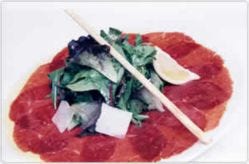
Most people who love food, especially Italian food, know that beef Carpaccio is a dish that consists of paper-thin slices of raw beef served with olive oil, arugula and Parmesan cheese. It was invented by Giuseppe Cipriani of Harry’s Bar in Venice and named after the great Venetian artist Vittori Carpaccio (1460?-1525/6). The point is, I mean my point is, that “carpaccio” is not a technique; it’s a dish, which could (one grants) have some acceptable range of variation — one pictured here has truffles,
which seems like over-kill — but still must necessarily operate within its proper sphere. I could see lamb Carpaccio, for example, treated in the regular manner, but I have also been served shrimp Carpaccio and octopus Carpaccio, and I would say that those concepts are beyond the pale.
Today, you see, carpaccio has become the new napoleon. What I mean is that 10 to 15 or more years ago, witty (or desperate) chefs expanded the notion of the luxurious dessert called a napoleon — layers of puff pastry alternating with pastry cream, whipped cream or jam and topped with fondant icing, traditionally with combed brown and white stripes — to mean any group of
ingredients stacked in layers. Hence, lobster napoleons, hence sweetbread and foie gras napoleons. The limit, for me, was reached at La Maison Blanche, in Paris, in March 1990, where I was served a “napoleon” that stacked, carefully, eel with eggplant and zucchini. Sorry, but that sounds like vertical ratatouille to me.
(What I chiefly remember about the restaurant is that a large white German shepherd-like dog was sleeping right inside the front door, blocking the way in or out. Nobody paid attention; they just stepped over the dog. The French are sort of lovable after all.)
The connection between the dessert and the short Corsican conqueror seems to be the remarkable resemblance that the pastry napoleon bears to Napoleon’s Tomb at Les Invalides. Ha-ha, no, I made that up, it’s probably an association with
napolitain, the French adjective for Naples.
All right, F.K., you’re saying, you’re on one of your tears again.
Well, hell, yes, of course, because words have meanings and they matter, and the names of things, the names by which we know them — napoleons and carpaccio — have meanings and they matter. When those words and names are blurred and forgotten, we have lost something irreplaceable. When some master chef of the “Slicing and Dicing” class at the Culinary Institute of America blithely says, “O.K., apprentices, carpaccio those tomatoes for me and napoleon them on the plates,” we have doomed ourselves a little.
I’m just trying to keep that from happening quite so soon.
The image of the beef carpaccio at top is from abc.net.au; the second carpaccio (with truffles) is from atmospherebistro.com. The napoleon is from grahamdavies.net; Napoelon’s tomb is from sagarmatha.com. Thanks to all.
June 17th, 2007 at 1:53 pm
Once again I agree with you and I would like to add that the Parmigiana is a plate based on eggplant, cheese and tomato…so no chicken Parmigiana, shrimp Parmigiana and whatever other Parmigiana people can invent!!!
Buona Bevuta a Tutti
June 17th, 2007 at 10:40 pm
I think this is only going to get worse with the current culinary fads. Thomas Keller’s ice cream cone made of minced salmon, Ferrán Adriá’s apple caviar, etc. You’ve previously pointed out the menu abuses of risottos and martinis; I think there’s enough of a trend to merit a neologism. May I suggest pseudotrophe, which aside from some obscure taxonomic usage means “false nutrition” in Greek?
At least in the old days they were courteous enough to put the word mock in the title, like mock turtle soup (made with assorted cow parts) and mock apple pie (made with Ritz crackers).
June 18th, 2007 at 8:01 am
I will be sure to use “pseudotrophe” at the earliest opportunity.
June 18th, 2007 at 8:13 am
Use it only in association with acids which “ring”, “chime” or “clang.”
June 18th, 2007 at 12:59 pm
or go “ka-ching.”
June 20th, 2007 at 9:13 am
My, my, this tickles my funny bone a little too early in the morning!
In our defense, much pressure is put upon us chefs these days to push the envelope, and, quite frankly, there are very few avenues left unexplored.
I think the trend began as a way to show off one’s wit, much as you all enjoy doing (witness your comments), but I agree, has been taken so far that folks not familiar with the true meaning of napoleon might be led astray.
Fredric, may I request, while you are saving the world, that you attempt to stop folks from using folk’s to delineate the plural of folk? It’s my most unfavorite entry in the evidence that suggests the doom you refer to in your blog. Please!! My grandfather, the English professor, is rolling in his grave!
And while I’m at it, the wine! Sierra Vista Chardonnay was nowhere to be found when I removed my salmon from the grill. Come to find out, my father had thought it an early Father’s Day present, and had absconded with it.
I purchased another, and enjoyed a glass last night. I’m thinking it might’ve been a bit too competitive with my light and delicate wild salmon, but I have more, so I’ll try the two today. I loved the wine! Thank you!
June 20th, 2007 at 9:15 am
Shrimp parmigiana? Not only does it show a lack of understanding of Italian cuisine, in which rarely if ever is cheese added to fish or seafood; But its part of an
annoying (no to mention unhealthy) trend in
many ordinary American restaurants, pubs, fast-food joints, etc to put cheese on EVERYTHING.
Its gotten to the point now that, rather than ask for cheese to be put on a sandwich, salad, burger, etc, you have to ask them - sometimes more than once - NOT to put any cheese on it, if you don’t want any.
Last week, in a local pub, I ordered a grilled chicken sandwich without the cheese and bacon
indicated on the menu. The waiter looked at me and said, “no cheese and no bacon? You mean just chicken?”
The sandwich was to my table without bacon but still with a huge glob of cheese.
I reminded the waiter of my request, so he took it back, and next brought it to the table without cheese, but this time with,… you guessed it,… bacon. Upon seeing my look of surprise he realized the error, grabbed the plate again, muttering something about the kitchen staff not being used to requests like this.
Exactly the problem.
June 20th, 2007 at 7:24 pm
The only avenue left unexplored might be a “Napoleon capraccio” of FOAMS as an hommage to Adria’ whatsisname. I’m waiting.
As for the cheese on everything phenomenon, it’s pretty repulsive. It glops up otherwise fairly healthful food (your chicken) plus the cheese itself is usually terrible, kind of vomity and such.
Have I told you lately that I miss Italy? Well, bub, I’m telling you again.
June 21st, 2007 at 11:29 am
Oh, God, I’d almost forgotten the Napoleon craze. Now I remember. “Banana Crepe Suzette Napoleon.” “Phyllo Napoleon with Olive Tapenade.” STOP THE MADNESS. Although I like Terry’s idea of a Napoleon carpaccio–maybe its a deconstructed Napoleon, reduced to pastry flakes and arranged in a circle??
June 21st, 2007 at 11:57 am
Debs, stop it, you’re killing me.
We’ll probably see that one any day at some sleek minimalist place with no sign down in the LES.
June 24th, 2007 at 2:09 pm
Wait for the next craze - everything a tiramisu! Just kidding I hope. I’ll have that with a dessert Caesar, er, Cesar. At least ‘martini’ is not a verb, yet…
June 24th, 2008 at 8:58 am
[…] (photo swiped from biggerthanyourhead.net) […]