Sun 4 Feb 2007
Readers familiar with BiggerThanYourHead know that I am — damn my eyes! — a purist through and through, a position that isn’t always fun because it lets one in for a great deal of disappointment. 
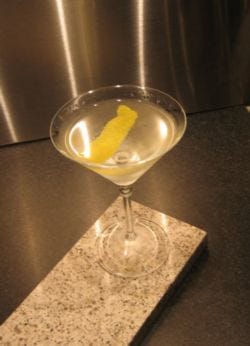
But in reading the new “Platinum Edition” of Mr. Boston (John Wiley & Sons, Inc., $19.95), the bartender’s guide that’s been around in many editions since 1935, I was struck by this assertion by Anthony Giglio, who revised the book for this recent printing. He is recounting recipes for martinis as they existed a century ago and includes a recipe for what he indicates is a more authentic version of the martini than we consume so avidly today, that is too say, the dry martini, for among all other matters to which the 20th Century can lay claim, one, of certainty, is that the martini became progressively drier.
Giglio’s recipe is this: 1 oz. gin. 1 oz. dry vermouth. 1 dash orange bitters. Stir with ice, strain into a chilled cocktail glass. Garnish with a lemon twist.
Giglio says: “Another difference you’ll see is what appears to be a massive amount of vermouth being used. The result is a drink that bears little resemblance to today’s Martini. Push your prejudices aside and instead focus simply on the overall taste of the drink itself, and you’ll find the vermouth is not only enjoyable but in perfect balance with the gin.”
Wow, I thought, this guy is as much a purist as I am!
So I did that. A couple of days ago I made LL and me each a martini following Giglio’s recipe. The result: Gack!
Sorry, I’m just a four (or 3.5) parts gin to one part vermouth person and there’s no getting over it. Is anything else in the world as clean as this nun of a cocktail, as pure, as chastening? We do use the lemon twist. I agree with Giglio, that “the olive brine affects the delicate balance of the drink.” Longtime devotees of Tanqueray, we also like the Scottish gin Hendricks, though some criticize it as too floral, and Junipero, from Anchor Distillery in San Francisco.
And it’s strange that Giglio, along with every other writer on cocktails and their history and preparing, insists that a martini be stirred, not shaken. Shaking is for fruity cocktails, all the experts agree; stirring is for cocktails that combine spirits. Yet go into any bar between the shining seas and order a martini and the bartender will put the gin and vermouth in a shaker with ice and shake the holy crap out of it, breaking up the ice, so that the moment the martini is poured into your glass it’s already diluted. You don’t have to be Werner von Braun to understand that this procedure is counter-productive.
When you ask bartenders why they do this, they inevitably reply, “So the martini will be cold.” No, the way for the martini to be cold is to do what I do at home: keep the gin in the freezer and the vermouth in the refrigerator. And it is, of course, of utmost importance that the martini be achingly, bone-chilling cold, because if it isn’t, in five minutes you just have a cute little glass filled with warm alcohol. Yum.
As to all the seemingly hundreds of variations on the “martini” that adorn “martini lists” through out the land, the less said of them the better. Vermouth exists for a higher purpose in life than to give an echo of character to vodka.
By the way, my favorite recent cocktail books are Cocktail: The Drinks Bible for the 21st Century by Paul Harrington and Laura Moorhead (Viking, 1998) and New Classic Cocktails by Gary Regan and Mardee Haiden Regan (Macmillan, 1997), each in its way a model of history, lore, wisdom and imagination.
February 5th, 2007 at 2:04 am
When it comes to martinis, I am a traditionalist in that I enjoy the roughly 4-1 ratio of good gin (I love Citadelle) to vermouth, and I look down upon those who put their vermouth in a mister or–God forbid–swirl the delicate wine in a glass and dump it out before adding the gin.
(I’m not afraid to say it: vermouth is delicious, and it is an excellent liquid to toss over fish that is baked or cooked in a skillet.)
I do prefer to add a few tiny strips of lemon zest via a zester, and I think that the garnish of a standard martini can provide some interesting tastes. My personal favorite is a cherry tomato, cut in half, each piece speared on a toothpick on opposite sides of a bleu-cheese stuffed olive.
A caprese garnish is also fun: a bollito of fresh mozzarella, a cherry tomato, and a big basil leaf all on a toothpick.
Despite these variations–which really marry flavors quite well–I still think such creations as the “Chocotini” are ridiculous.
February 5th, 2007 at 3:22 am
Martinis are shaken because James Bond, as personified by Sean Connery, ordered his (vodka) Martini that way – and no one will deny that 007 was the sexiest fictional cat of the 20th century. Also, I get the impression it is easier and quicker for the bartender to shake….
Of course Bond did not order his Martini shaken to be sexy, rather – he ordered them that way precisely because the alcohol was diluted more and he wanted to be on his toes. So to speak… Ian Fleming definitely knew his spy-craft.
I for one am sick and tired of feeling like the Titanic maneuvering my way through a sea of ice shards floating in a cocktail glass. They can darn well stir my drinks.
As far as I am concerned, stirred is the sexy of the 21st century – unless of course you are in fact a spy…
February 5th, 2007 at 8:38 am
Wait a sec, Mr. B., you put a bleu-cheese-stuffed olive surrounded by a cherry tomato IN the martini? Or nibble it on the side? And the mozzarella? You’re a brave man to admit this innovation in a public forum.
February 5th, 2007 at 3:37 pm
My father would be turning over in his grave at the thought of Giglio’s concoction. I can remember him saying, on many an occasion, “a dry martini is a glass of very cold gin over which one whispers, ‘vermouth’”.
Nothing to stir or shake. Sip in peace, dad.
February 5th, 2007 at 3:52 pm
In response to the garnish: when I grow the tomatoes and basil myself, it’s not quite as embarassing. Yes, I skewer those combinations on toothpicks and let them reside in the glass while drinking. If the conditions are just right the juices from the tomato flow into the martini and the saltiness of the cheese and/or olives help out in a wonderfullly subtle way. The consuming of the garnish at the end provides for a powerfully savory appetizer, and again, if you’re using real vermouth as it’s intended, all of the herbal flavors come together to give your mouth a real treat.
I’ve actually converted martini-haters with this trick, and feel that it’s an appropriate improvisation that still holds true to the taste of the original. It’s not like I’m throwing in Blue Curaçao and giving it a name generally associated with a sex act.
The trick with the tomatoes is that they have to be split in half; otherwise the juices can’t swirl around.
On the other hand, the pearl onion in a Gimlet does nothing for me. The funniest garnish I ever heard of was in a beverage called the Mother Teresa, invented by Spider Robinson in one of his novels: a martini with a mournful prune resting in the bottom of the glass.
February 17th, 2009 at 4:46 pm
Ciekawa strona, dodalem ja do ulubionych, zapraszam do odwiedzenia mojej
April 23rd, 2009 at 7:18 am
my week is saved – interesting blog here